


MARK Climate Technology distributor in TürkiyeElburz Mühendislik
Gas-Fired Air Heaters
Heat a warehouse or production area without a central hot-water network, supplying warm air directly or distributing it through ducts.
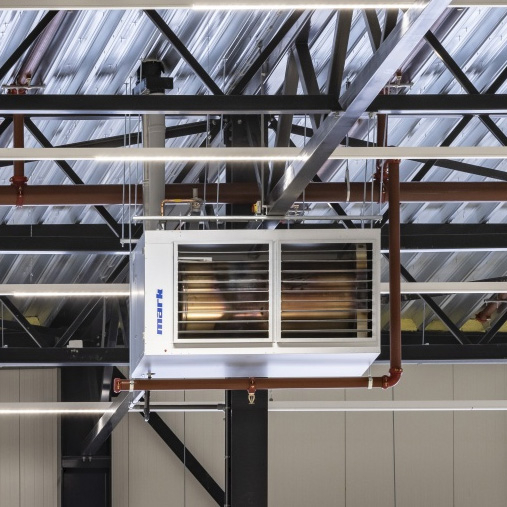
Gas-fired air heating matched to the layout
How does it work?
Heat is generated in the unit and transferred to the airstream through a heat exchanger. GS+ and GSX serve free-blowing layouts; GC+ and L-TYPE can serve suitable ducted arrangements.
Where does it fit?
Workshops, garages, warehouses and production halls. Air throw matters for direct discharge; airflow and available external pressure matter for ducted systems.
Heat a production hall without a central hot-water system
In a warehouse or workshop with gas available, use direct discharge for an open layout or ducts to reach separate work zones. Plan gas supply, combustion air, flue arrangements and service access together.
Delivering warm air where it is needed
Illustrative application scenario; not a completed customer project.
A production hall requires the heater to sit in a defined location while warm air is distributed to different working zones through ducts. The air distribution must suit the project as well as the heating output.
Ducted heating
GC+ and L-TYPE are MARK product families that can be assessed for duct-connected applications.
A suitable layout
Available space, discharge direction and maintenance access influence the equipment arrangement.
A defined quotation scope
The operating point, burner, fan, controls and accessories are agreed together.
MARK gas-fired air heater comparison

GS+ high-performance air heater
View the manufacturer’s source for this model and its technical details.

GSX gas-fired air heater
View the manufacturer’s source for this model and its technical details.

GC+ air heater with a centrifugal fan
View the manufacturer’s source for this model and its technical details.
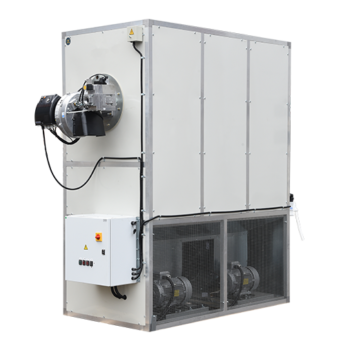
L-TYPE vertical or horizontal air heater
View the manufacturer’s source for this model and its technical details.
GS+ and GSX use axial fans for free-blowing space heating. GC+ uses a centrifugal fan for ducted applications, while L-TYPE offers vertical or horizontal layouts and a wider capacity range.
| Product family / series range | Technical features | Applications / air distribution |
|---|---|---|
| GS+ ↗13.6–142.2 kW | Condensing; modulating premix burner and axial fan. Stainless steel heat exchanger; optional EC fan. | Free-blowing heating in warehouses, workshops and showrooms. Condensate drainage required. |
| GSX ↗13.7–84.6 kW | Premix burner; standard speed-controlled EC axial fan. Stainless steel heat exchanger; no condensate drain pipe required. | Free-blowing heating in garages, workshops and warehouses without a hot-water distribution network. |
| GC+ ↗15–150 kW | Condensing; 5:1 modulating premix burner and centrifugal fan. Manufacturer-stated system air pressure up to 300 Pa. | Ducted heating and integration into an air handling unit. Optional outdoor version. |
| L-TYPE ↗30–600 kW | Vertical or horizontal construction; centrifugal fan. Available with a two-stage Low-NOx gas burner; optional increased external pressure of 300 Pa. | Space heating with an optional discharge hood, or duct connection. Filter and outdoor installation options. |
Capacity and pressure: Ranges are the series capacities stated on MARK product pages, not the modulation range of an individual unit. Useful heat output, airflow and available external static pressure are confirmed at the same operating point for the selected model. 300 Pa is not available at every airflow; it is an option for L-TYPE.
Product names link to the manufacturer’s technical pages. Detailed model data and control options are available in the technical documents.
Project information and related solutions
Which option suits your project?
Share the required air distribution and operating conditions before fixing a model. Elburz assesses a suitable standard MARK option with the manufacturer, clarifying the technical requirements and quotation scope together.
For an initial assessment
- Required useful heat output and indoor temperature
- Required airflow and duct / filter pressure losses
- Unit location, duct layout if available and fresh-air requirements
- Gas and electrical supply, operating hours and control requirements
Need heated outdoor air to replace high extract volumes?
Explore this different requirement in the CALFLO make-up air scenario.
Technical selection and installation
Free blowing or ducted supply
GS+ and GSX use axial fans for space heating. GC+ uses a centrifugal fan for ducted applications; MARK states system pressure up to 300 Pa. Verify airflow, available pressure and duct losses together.
Condensate and flue
GS+ and GC+ are condensing solutions; plan drainage routes and freezing conditions. MARK states that GSX does not require a condensate pipe. Select combustion-air and flue arrangements from each model’s manual.
Controls and zones
Consider OptiTherm+ or suitable Interface+ integration with a BMS. GSX offers control of up to eight units on a two-wire bus. Coordinate gas-heater and MISTRAL hybrid sequencing on a project basis.
Technical documents
Use the manufacturer links above for product details. Final selection is confirmed against current technical documentation and project conditions.
Product information: MARK Climate Technology and the Elburz–MARK product brochure. Product availability and options are confirmed at quotation stage.
Manufacturer manuals and product data
Sources checked: 15 November 2026. Confirm the selected configuration and operating conditions with current manufacturer documents.
Let’s discuss your project
Share your application and project requirements. We coordinate product selection, quotation and supply with MARK.