

MARK Climate Technology distributor in TürkiyeElburz Mühendislik
Destratification fans
MARK solutions that bring warm air beneath the roof back to the occupied zone. Explore ECOFAN W and P140 models, technical specifications and control options.
Bring the heat back down
In high-ceiling buildings, rising warm air can create a temperature difference between the roof and occupied levels. Destratification recirculates indoor air to reduce this layering and support the existing heating system.
The aim is a more even temperature distribution in factories, warehouses, workshops and commercial spaces. The fan does not generate heat or supply fresh outdoor air.
Schematic illustration.
MARK ECOFAN W and P140 comparison
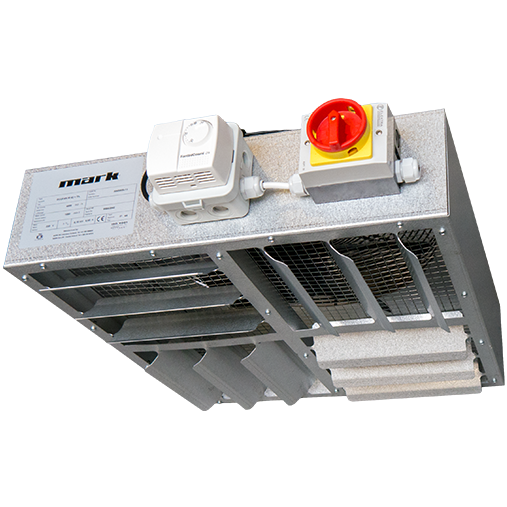
ECOFAN W is a cased destratification fan with directed downward discharge. P140 uses an open-blade ceiling fan design to circulate room air. Both support the existing heating system; neither generates heat nor supplies outdoor air.
| Product family | Technical design / control | Air distribution / applications |
|---|---|---|
| ECOFAN W ↗Cased industrial fan | Aluzinc casing; integrated thermostat and isolator switch. Standard four-sided downflow hood; optional speed-controlled EC motor. | W42, W82 and W142; series airflow range of 4,000–14,000 m³/h. Transfers warm ceiling-level air towards the occupied zone in industrial halls, workshops and logistics areas. |
| ECOFAN P140 ↗Open-blade ceiling fan | Standard RAL 9010 finish and safety cord. Speed control is not included; a thermostat that starts the fan as ceiling temperature rises is optional. | Air circulation in factories, schools, shops and offices. Its air distribution differs from the W series’ directed downward discharge. |
Airflow and mounting: Equal airflow ratings do not imply equal air throw or coverage across different fan designs. W model mounting ranges and P140 specifications are listed below. The special Ex version of the W series requires confirmation for the ordered model and site conditions.
ECOFAN W technical specifications
| Specification | W42 | W82 | W142 |
|---|---|---|---|
| Airflow (m³/h) | 4,000 | 8,000 | 14,000 |
| AC motor power (W) | 150 | 360 | 535 |
| EC motor power (W) | 125 | 320 | 620 |
| Power supply | 230 V / 50 Hz | 230 V / 50 Hz | 230 V / 50 Hz |
| Weight (kg) | 18 | 24 | 34 |
| Mounting height (m) | 4–8 | 7–13 | 10–18 |
Source: MARK ECOFAN W technical manual, 06 60 500_R18. W142 with a cone attachment is assessed separately for heights of 18–30 m. These are manufacturer model specifications; the final unit and accessories are defined in the quotation.
What does an EC motor offer?
It allows speed control and efficient part-load operation. The full-load motor power shown in the table does not, on its own, indicate annual energy use; consumption depends on operating speed and hours.
ECOFAN P140 technical specifications
The ceiling fan and the housed W series distribute air differently. They should not be considered interchangeable on airflow figures alone.
The figures below are from the P140 table in MARK’s 2025 product catalogue. Specifications for the current supply model are confirmed at quotation stage.
| Airflow | 22,000 m³/h |
|---|---|
| Motor power | 67 W |
| Fan diameter | 1,400 mm |
| Power supply | 230 V / 50 Hz |
| Weight | 5 kg |
| Suspension height | 4–9 m |
Temperature-difference control: RJ402
RJ402 controls ECOFAN fans using the temperature difference measured by two sensors at occupied-zone and ceiling levels. MARK supplies this controller together with PinTherm Connect.
Two measuring points
One sensor is at occupied-zone level and the other is near the ceiling.
230 V / 50 Hz
Controller power supply; the manufacturer specifies its own power consumption as less than 0.5 W.
Controls matched to the project
Control equipment is selected to suit the fan model, motor type and total load. RJ402 is a separate control component, not a fan.
Application questions
How much energy can it save?
MARK states that ECOFAN W can reduce gas consumption by up to 30% in some applications. This is not a guarantee for every building. Results depend on temperature stratification, building characteristics, the heating system and fan control.
How do we determine the number of fans?
Share the hall dimensions, ceiling height, internal obstructions such as racking or cranes, and the existing heating system. Elburz assesses the suitable product and layout together with MARK.
Does it replace heat recovery ventilation?
No. Destratification recirculates indoor air. Fresh-air and extract-air requirements need separate air handling and heat recovery solutions.
Technical sources and documents
This page is a technical summary prepared by Elburz. Refer to the manufacturer’s original manuals for installation and electrical connections.
Sources: MARK product pages, ECOFAN W R18 technical manual and MARK 2025 product catalogue (P140). Technical content checked: 24 September 2026.
Let’s discuss your project
Share your application and project requirements. We coordinate product selection, quotation and supply with MARK.